 クリーンルーム用フォームスワブ, ポリエステル綿棒, プリンタークリーニングキットメーカー | MediTech
In industries where even microscopic particles can affect product quality, critical cleaning is an essential part of manufacturing and maintenance. 半導体製造, 医薬品, 医療機器, 光学, 航空宇宙, エレクトロニクス, and other precision industries require cleaning processes that remove contaminants without introducing new particles, 繊維, or residues.
Unlike conventional cleaning, critical cleaning focuses on controlling contamination at every stage—from selecting the cleaning tool and solvent to controlling the cleaning technique and handling process.
Among the tools used for precision cleaning, クリーンルームスワブ provide a practical solution for cleaning small surfaces, narrow gaps, 凹んだ領域, and other difficult-to-reach locations.
What Is Critical Cleaning?
Critical cleaning refers to cleaning processes performed when surface cleanliness directly affects product performance, manufacturing quality, 信頼性, or regulatory requirements.
Typical contaminants may include:
- 粉塵と浮遊粒子
- Fibers and lint
- オイルとグリース
- 指紋
- Flux and adhesive residues
- Process chemicals
- Fine particles generated during manufacturing
- Other organic or inorganic residues
The objective is not simply to make a surface look clean. A critical cleaning process is designed to reduce contamination to an appropriate and controlled level while minimizing the possibility of recontamination.
This makes material selection particularly important. Cleaning tools must be compatible with the surface, cleaning agent, and contamination-control requirements of the application.
Why Critical Cleaning Matters
A small amount of contamination can create significant problems in precision manufacturing.
例えば, particles on optical surfaces can affect transmission and image quality. Residues on electronic components can interfere with electrical performance. Contamination during medical device manufacturing may compromise product quality and process control.
Critical cleaning can therefore help manufacturers:
- Reduce particulate contamination
- Improve surface cleanliness
- Protect sensitive components
- Reduce manufacturing defects
- Support consistent production processes
- Maintain equipment performance
- Improve the reliability of precision products
The cleaning method should always be selected according to the specific application, 材料の適合性, and applicable process requirements.
The Role of Cleanroom Swabs in Critical Cleaning
クリーンスワブ are specialized cleaning tools designed for contamination-sensitive applications. They are commonly manufactured using materials such as polyurethane foam, 編まれたポリエステル, またはマイクロファイバー.
Their compact size allows operators to clean areas that are difficult to access with conventional wipes.
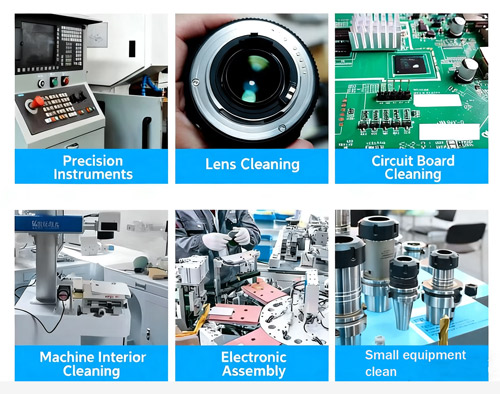
Typical applications include:
- Cleaning electronic components
- Removing residues from fixtures and equipment
- Cleaning optical components
- Precision cleaning of sensors
- Cleaning semiconductor manufacturing equipment
- Removing particles from medical device components
- Cleaning connectors and recessed areas
- Applying or removing cleaning solvents
Cleanroom Swab Material Comparison
Choosing the correct material can make critical cleaning more efficient.
| スワブの材質 | Main Characteristics | Typical Applications |
|---|---|---|
| フォーム | 吸収性, 柔らかい, good liquid retention | 精密クリーニング, 溶剤の塗布, エレクトロニクス |
| ポリエステル | Durable, low-lint, solvent compatible | クリーンルーム, 医療機器, semiconductor equipment |
| マイクロファイバー | 柔らかい, fine fiber structure, excellent particle capture | 光学, センサー, エレクトロニクス, 精密機器 |
| ESD-Safe Swab | Designed for static-sensitive environments | Electronics and sensitive components |
The correct selection should always consider the specific cleaning process, surface material, 溶剤適合性, contamination requirements, and applicable industry procedures.
MediTech offers a broad range of cleanroom swabs, 含む フォームスワブ, ポリエステル綿棒, マイクロファイバースワブ, and ESD-safe swabs for different precision-cleaning requirements.