 Reinraum-Schaumtupfer, Polyester-Tupfer, Hersteller von Druckerreinigungskits | MediTech
Präzisionsinstrumente sind für den Betrieb mit äußerst hoher Genauigkeit ausgelegt. Ob in der Optik verwendet, Elektronik, Labore, medizinische Geräte, Halbleiterfertigung, oder Industrieinspektion, these instruments often contain delicate components and narrow spaces where even tiny particles, Ölrückstände, or fibers can affect performance.
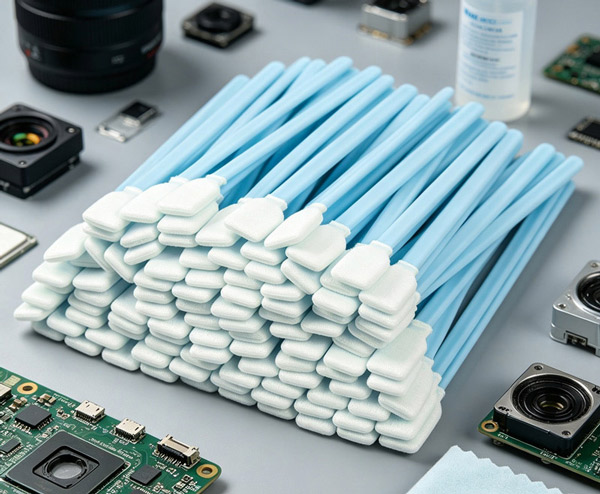
For this reason, Reinraum-Tupfer have become an important tool for precision cleaning and contamination control. Unlike conventional cotton swabs, cleanroom swabs are specifically designed to minimize particle generation, Fussel, Rückstand, and contamination during cleaning.
In diesem Artikel, we explore the application of cleanroom swabs in precision instruments, the advantages of different swab materials, and how to choose the right swab for your cleaning requirements.
Why Cleanliness Matters for Precision Instruments
Precision instruments often contain components that are sensitive to dust, Fingerabdrücke, Öle, Feuchtigkeit, statische Elektrizität, and chemical residues.
Contamination can cause:
- Measurement errors
- Optical distortion
- Sensor malfunction
- Electrical connection problems
- Reduced equipment performance
- Oberflächenschaden
- Increased maintenance requirements
- Product quality issues
Zum Beispiel, a small particle on an optical sensor or lens can interfere with light transmission and measurement accuracy. Similarly, contamination on electronic contacts can increase resistance or interfere with signal transmission.
Using a properly designed cleanroom swab allows operators to clean these sensitive areas more precisely while reducing the risk of introducing new contaminants.
Applications of Cleanroom Swabs in Precision Instruments
1. Optical Instruments and Lenses
Optical systems are particularly sensitive to dust, Fingerabdrücke, Öl, and fibers. Mikroskope, Kameras, optische Sensoren, laser equipment, and inspection systems may contain delicate optical surfaces that require careful cleaning.
A cleanroom swab can be used to remove:
- Staubpartikel
- Fingerabdrücke
- Oil residues
- Fine debris
- Reinigungsrückstände
Microfiber swabs are particularly suitable for delicate optical surfaces because their soft structure can provide effective particle and residue removal while minimizing the risk of scratching.
MediTech offers microfiber swabs in multiple head shapes and sizes for precision cleaning applications, einschließlich rechteckig, runden, spitz, paddeln, and miniature designs.
2. Camera and Image Sensors
Image sensors require extremely careful cleaning because dust or oil on the sensor surface can appear as visible spots in photographs and images.
MediTechs 16MM APS-C-Sensorreinigungsabstrich is specifically designed for cleaning sensitive camera sensors, optische Linsen, and photosensitive components. It uses a microfiber polyester head and polypropylene handle, with a total length of 124 mm and a 16 mm Kopfbreite. Both dry and pre-wet versions are available.
The swab is also suitable for precision instruments and sensitive electronic equipment where controlled, lint-free cleaning is required.
3. Electronic Sensors and Circuit Components
Precision instruments increasingly incorporate electronic sensors, Leiterplatten, Anschlüsse, and miniature components.
These components can accumulate:
- Staub
- Flussmittelrückstände
- Öle
- Fingerabdrücke
- Feine Partikel
- Manufacturing residues
Cleanroom foam and polyester swabs can reach areas that are difficult to access with conventional wipes.
For static-sensitive electronics, ein ESD-safe swab can provide an additional level of protection by helping control electrostatic buildup during cleaning. MediTech offers ESD foam and polyester swabs for applications including electronics, Mikroelektronik, optische Geräte, und Präzisionsinstrumente.
4. Fiber Optic Components
Fiber optic connectors and components require highly controlled cleaning because contamination on connector end faces can affect optical transmission.
Cleanroom swabs can be used around:
- Steckerschnittstellen
- Small grooves
- Ausgesparte Bereiche
- Equipment housings
- Hard-to-reach components
MediTech’s cleanroom-swab range includes specialized Glasfaser-Reinigungstupfer designed for precision cleaning applications.
For narrow or recessed areas, a pointed or tapered swab can provide better access than a conventional flat cleaning tool.
5. Semiconductor and Microelectronics Equipment
Semiconductor and microelectronics manufacturing requires strict contamination control. Even very small particles or residues can affect sensitive components and manufacturing processes.
Cleanroom swabs are commonly used for precision cleaning around:
- Semiconductor equipment
- IC-Komponenten
- Leiterplattenbaugruppen
- Anschlüsse
- Sensoren
- Small mechanical components
- Assembly fixtures
MediTech manufactures cleanroom foam, Polyester, Mikrofaser, and ESD-safe swabs for contamination-sensitive applications. Its cleanroom swabs are designed for use in high-cleanliness environments and are manufactured with controlled processes to reduce contamination.
Choosing the Right Cleanroom Swab for Precision Cleaning
Not every cleanroom swab is suitable for every application. The following factors should be considered when selecting a precision cleaning swab.
Tupferkopfmaterial
Foam swabs are useful for absorbing and removing particles, Öle, und Rückstände. Their compressible tips can conform to irregular surfaces and reach small spaces.
Polyester swabs offer durability, geringe Partikelbildung, and good chemical compatibility. They are widely used in cleanrooms, Elektronik, Optik, medizinische Geräte, and other contamination-sensitive applications.
Microfiber swabs provide a soft cleaning surface with strong particle and residue capture, making them particularly useful for sensitive optical and electronic surfaces.
ESD-sichere Tupfer are recommended when cleaning static-sensitive electronic or precision components where electrostatic discharge is a concern.
Tip Shape and Size
The geometry of the swab is equally important.
- Round tips: Suitable for general precision cleaning
- Rectangular tips: Useful for broader flat surfaces
- Pointed tips: Ideal for grooves, Ecken, and narrow spaces
- Miniature tips: Designed for very small components
- Long handles: Useful when cleaning recessed or difficult-to-access areas
- Double-ended swabs: Can provide two cleaning surfaces in one tool
MediTech’s cleanroom-swab portfolio includes numerous tip shapes and handle configurations, allowing customers to select a design according to their specific cleaning requirements.
Why Choose MediTech Cleanroom Swabs?
MediTech provides a broad range of cleanroom swabs for precision cleaning and contamination-control applications, einschließlich:
- Reinraum-Schaumtupfer
- Reinraum-Polyestertupfer
- Cleanroom microfiber swabs
- ESD-sichere Tupfer
- Sensor cleaning swabs
- Glasfaser-Reinigungstupfer
MediTech has focused on cleanroom consumables since 2014 and provides OEM/ODM services for customers requiring customized swab designs, Materialien, Verpackung, and specifications. The company operates integrated manufacturing processes for swab handles, fabric and foam processing, head forming, inspection, and final packaging.
This makes MediTech a suitable supplier for distributors, OEM manufacturers, private-label companies, and industrial users looking for customized precision-cleaning solutions.
Best Practices When Using Cleanroom Swabs
To obtain consistent cleaning results, follow these basic practices:
- Select the appropriate swab material for the surface and contaminant.
- Choose the correct tip size and shape for the area being cleaned.
- Use a compatible cleaning solvent when required.
- Avoid excessive pressure on delicate optical or electronic surfaces.
- Use each swab according to the manufacturer’s instructions.
- Avoid reusing contaminated swabs.
- Keep unused swabs properly sealed until use.
- For ESD-sensitive components, use an appropriate ESD-safe swab.
- Follow the instrument manufacturer’s cleaning procedure whenever available.